Photography has been my saving grace throughout the pandemic. This September I am happy to participate in the Annual Sydenham Arts Artists Trail, exhibiting (both in print and digitally) some of the many photos I took during and in between the lock-downs, as well as a few of the best I have been taking throughout the years.
I will be exhibiting during the second weekend only, September 10 & 11, at Forest Hill School, Dacres Road, SE23 2XN, and these are the images that will be on display and ready to buy (mounting, sizes & prizes tbc).
Buoyant. Mount’s Bay, Cornwall, Summer 2020Cascading. Morley College, studio session, Photography Level 2, 2018/2019Castlerigg, Bird. Keswick, Lake District, Autumn 2021Castlerigg, Stone Circle. Keswick, Lake District, Autumn 2021Ducks In A Row. Derwentwater, Lake District, Autumn 2021Fading. Norfolk, Summer 2022Feather, Wet. Hartwell House, Autumn 2020Ice Ice Baby. Diamond Beach, Iceland, October 2019Jellyfish. Monterey Bay Aquarium, USA, Summer 2015Red In The Forest. Bruges, Belgium, Spring 2022Solo. Vestrahorn mountain & Stokksnes beach, Iceland, October 2019They Are Here. London, Winter 2018Us. Tintagel Castle, Cornwall, Summer 2022
A timely, allegorical thriller that never loses sight of its humans as it tracks a mysterious, uncontrollable virus haunting the UK.
A great start doesn’t make a great book. Still, a great start is exhilarating. It lures you in and keeps you reading. And more often than not it proves to be a very good omen for what follows. The start of Panik is and proves to be all the above.
It begins firmly grounded to reality in order to introduce us to Rosa – one part of its leading (un)holy trinity of characters. We meet her as her life comes undone when her adopted father and mother become two of the very first victims of the brutal, puzzling new illness that spreads like a virus. At this point the only odd element is Ana – Rosa’s inner voice and guardian.
When we next meet the other two of the trinity some time has passed and ‘odd’ has become too little a word to describe what is happening. Oxford is cordoned off, people are struggling to stay awake, and the government desperately tries to control not only the Panik, but also the hysteria that threaten to wipe England and Wales off the map. Metaphysical and surreal elements creep into the narrative more and more now, while the intriguing unanswered questions keep multiplying. At the same time some passing comments by Rosa’s brother make implicit Chris Selwyn James’ intention to write this book as a response to/allegory for Brexit. But as the new Coronavirus spreads around the world, his work becomes, unintentionally, even more relevant. And that’s the only reason why some may find Panik’s venturing into the genre of Fantasy and the supernatural somewhat off-putting.
But for the rest, back on paper, people keep falling asleep, and dying. And the government in tandem with big pharma keep making plans, and failing. And the haunting questions keep on coming, with no answer in sight, as traces of horror are fittingly introduced into the story. All the while James never loses his focus on his three main (anti)heroes and all their flawed, neither only good, nor merely bad, always grey and never black & white humanity. In the end that you could never have predicted and stays with you, open, inconclusive, as you struggling to decipher it, fear is revealed as the most potent virus and compassion its only possible cure.
A promising, full of possibilities starting point of a YA fantasy series that stands out for the rich, multilayered world it invents.
Possibilities is the pertinent, perfectly fitting word to Matilda Seer. As a group of orphan teenagers are thrust into another, surreal, welcoming and at once threatening universe, a lot become excitingly possible. But this is only the beginning.
As the teens are renamed and thus reborn into special to their new home, gifted beings, M.D. Allen introduces us to an imaginative new world of her own creation. Little by little, in attentive, affectionate detail the Inner Realm is revealed in (almost) all its marvelous expanses and nightmarish depths. From its luscious beaches, lakes and gardens, to the shady back alleys of its towns and the deathly darkness of the Black Mass Tunnels. From its imposing palaces, like Lord Rafe’s labyrinthine chambers to the enchanted cosines of the Quarry Cottage. From its extraordinary, heartwarming creatures, big and small, like its regal, wise trees or an unexpectedly brave rat, to the terrifying ones, such as the relentless Nighlings. And though the prospect for discovering and exploring further corners of the Inner Realm remains, this is an already well-thought and well-formed, engrossing world.
The same cannot be said for the characters of the Chosen or the relationships between them. But don’t get me wrong. As I said, possibilities is the key word and this is just the beginning. Everything is here, full of promise. The bones of all powerful, sometimes turbulent, yet solid and meaningful friendships – the ever present trope in YA literature by everyone from J.K. Rowling, Suzanne Collins and Richelle Mead, to Michael Grant and Philip Pullman – are definitely starting to form. So are the hints of an organically evolved, Yin and Yang of a romance in some of them, particularly between Matilda and Ethan. Concurrently questions about free will vs destiny are being asked, tricky, even painful dilemmas between personal and common responsibility arise, the lines between good and evil are more often than not blurred, and a discreet gender-blind narrative tendency becomes more and more discernible.
And even though at times there seems to be character obvious description instead of character implicit development, the main plot twist/revelation (of who is doing the tracking) eventually clarifies both the author’s intentions and some of her characters’ behaviours. After all Matilda Seer is too much of a comfortable and comforting read for anyone to linger on its misgivings. And its open ending, fertile with unanswered questions and yes, possibilities, makes you want to escape back to it and keep reading its next chapter/book, aptly titled The Door.
Or how director David France documents a painful, hidden truth with some strategic digital disguises.
It all begins with a warning: “For their safety, people fleeing for their lives have been digitally disguised”. It is a fascinating warning. Who are these people? And how have they been disguised? Will their faces be pixelated, erased, what? As the socking, brutal answer to the first question starts to unfold, you grab hold of the second question and don’t let go. As if your preoccupation with it will somehow shelter you from the horrors you gradually become aware of.
This is the little-known story of a genocide: the deliberate extermination of the LGBTQ community in Chechnya. Not once upon a time. Now. It started in 2017, by accident we are told by David Isteev, the Crisis Response Coordinator of the Russian LGBT Network, which has worked tirelessly to get people out of Chechnya. “Imagine, in the 21st century, in a supposedly secular society,” he says, people are killed and maimed, even worse, families are urged to kill their own children or siblings simply because of their homosexuality. And suddenly the desperate plea of the woman on the phone in the first few moments of this film makes sense. She was begging for a way to escape the country, since her uncle found out her sexual orientation and was blackmailing her to have sex with him in order not to reveal her secret to her father who works for the government.
A government that is at the moment the source of all evils in Chechnya, led by Ramzan Kadyrov, who is enshrined in a more and more all-encompassing cult of personality. He is Putin’s man, doing Putin’s bidding. Thus ensuring that the infamous Russian strongman, having managed at long and very bloody last, to take control of Chechnya, turns a blind eye to Kadyrov’s poorest of records on human rights. But David France does not linger long on the apparent villains of this tragedy. He is not interested in why this is happening, as much as in the fact that this is happening. Not once upon a time. Now. And after all, in these “Trumped” times of ours, it is not too difficult to grasp how easily (and scarily) it has become for white, straight, populist men to rise to power and, once there, to get away with everything. Or that when our freedoms of speech and expression are pushed to the breaking point, those who are considered different, Other, (women and LGBTQ people in this case) are the first to pay the price.
No, France is keener on giving a voice to the unsung heroes (Isteev and his colleague Olga Baranova – a fugitive herself now) and the voiceless: the victims fleeing for their lives. So as the suspense on when and how the answer to the “digital disguise” question is mounting, you are presented with the basic facts, you get a glimpse of the violence against people of the LGBTQ community in amateur phone videos intercepted by the Russian LGBT network and finally, accompanying Olga, you arrive at the Moscow shelter. Here you meet some of the people rescued from Chechnya, most awaiting a visa to escape Russia altogether and flee to a more compassionate country (Canada mainly). Here the answer to the question you held on so tightly is finally answered. You think. Their faces are not actually altered, just blurred a bit – you hardly notice. You can still tell who is looking at you, who is talking to you – the human being behind the presumed mask. So, it’s safe to let go of the preoccupation that sheltered you, right?
You are now properly open and vulnerable just as this documentary becomes “Grisha’s” story. A 30-year-old who escaped Chechnya but must wait for his partner and his whole family to do the same, before they can all leave Russia. There are still some effectively placed references to Kadyrov and Putin, while the few, sparsely spaced intercepted phone videos become more and more unspeakable, yet extremely telling. There is also mention of the case of the disappearance of a gay pop star, as well as the follow up to the developments in the situation of the girl on the phone, nicknamed “Anya”. But it is “Grisha” who has become the beating heart of the film.
The silent tears in the arms of his partner when they reunite at the airport. The interlocking of their fingers. The sobs of his mother when they see each other again, putting her love for her son, pure and simple, above everything else: tradition, religion, a quiet and safe life. The accusation mixed with pride in his sister’s eyes. The easy, playful smile of his niece. “Grisha’s” own dilemmas, worries and hopes. And, finally his decision to stop running and speak up publicly.
In front of the press, as he implores the Russian government to investigate the ongoing atrocity in Chechnya, his true name, Maxim Lapunov, and face are revealed. And your jaw drops as your mind races to catch up with your emotions. His face was not simply blurred after all, it was utterly altered. As his piercing blue eyes face you for the first time you slowly but surely realise that all this time, he, along with all the other LGBTQ refuges were essentially hiding in plain sight. Exactly as their powerful abusers do, albeit using different methods. But while Maxim did it to protect himself and his loved ones, they, Kadyrov, Putin and all, do it to continue their ruthless rule with impunity.
This is the genius of this film. It shrewdly – just enough to draw your attention, without completely overwhelming it – uses a Deep Fake technique to uncover a difficult truth, engaging both your emotions and your mind. How apt and effectively ironic in the era of “fake news” and “alternative facts”. And how timely. As the end credits roll and you learn how many people the Russian LGBT network has evacuated from Chechnya, where things stand in Maxime’s case, and that the Trump administration, predictably, didn’t accept any LGBT refugees, it dawns on you that all the people that didn’t make it out in time, and all the people in similar predicaments around the world, are now, due to the pandemic, trapped, at home, with their abusers. Not once upon a time. Now.
Almost 10 years after his haunting ‘I Am Love’, Luca Guadagnino tells another “illicit” love story. Between two human beings that, for a brief moment in time, lived free of the rules of their gender, age and culture, in a world where there was no room for abuse of any kind.
Perlman family and guest around the table sharing food for thought. [Source: Sony Pictures Classics]What if there were no borders? No dividing lines, binaries or otherness? What if we all knew the History of words and could speak many languages, sometimes at once, flowing from one to the next? Much in the same way Elio Perlman (the wise beyond his years, Timothée Chalamet) and his family communicate in English and French and Italian and German and in silence. And like them, understood each other. Wonderfully subverting the myth of Babel, not falling into chaotic miscommunication, but ascending to tranquil empathy. What if we had more that one country or home, and the constant gaining of knowledge always trumped religion? As Mr (the wise… below his years Michael Stuhlbarg) and Mrs Perlman (the calm force Amira Casar), who are at the moment residing in the deeply catholic rural Italy, while being (cosmopolitan) Jews and having more than one base on both sides of the Atlantic.
What if we were gender-blind and didn’t fall in love with a boy or a girl, but simply with another human being? Anyway perfectly fitting in the unidentifiable as male or female underwear hanging from the bathtub tap to dry. Not unlike Elio, the sensitive, self-assured teenager, who knows so much but claims ignorance when it comes to “the things that matter”. Who has a fling and loses his virginity with a girl – a good friend, but won’t deny, ignore or leave unrequited his first big crush with Oliver (the unexpectedly audacious Armie Hammer): the seemingly “arrogant”, distant American, who is visiting as his father’s research assistant. What if we didn’t dismiss or forget the boldness and tenacity of youth on the cusp of adulthood? Instead, paid attention, cherished and surrendered to it. Even for only a few days of one, glorious summer. Striped down to the bare essentials of our being, unable to tell who is who, a she or a he, the 17 years old or the 24, you or I.
Flying, riding a bicycle. [Source: GIPHY]What if we explored History and Art as part of our everyday life, effortlessly? Read or study a book under the sun, play the piano after a quick bite or the guitar under a tree, combine a visit to an archaeological dig by the sea with an impromptu, playful swim. What if we could live more in sync with nature that sustains us without judgement, censorship or discrimination? Nature that “has cunning ways of finding our weakest spot”, which is perhaps our truest one if we are strong enough to acknowledge it. What if we ate the fruits of our garden and the fish of the sea nearby? What if we cried in the rain or in front of the fire, laughed in the water, kissed on the grass and flew in the air, riding a bicycle? Neither ignorant or innocent, nor experienced or sinful.
What if a parent submitted to the child’s experience and respected its choices and pain? Finding nothing wrong in falling in love with another, older (hu)man. Celebrating the unrelenting purity, sincerity and force of the first young love. Prompting the child to not kill the pain it feels so that it will not also kill the joy it felt. Lessening his or her own adult, “wise” experiences, not to make the child feel better, but to make it really see what it had, and remember always and regret it never. Because “we rip so much of ourselves to be cured of things faster than we should” even though “our hearts and our bodies are given to us only once”.
Elio and Oliver up the mountains, into nature. [Source: Sony Pictures Classics]What if a parent lied to his child, not because he thought it wouldn’t understand, but so that to spare it any embarrassment or shame? As Mr Perlman tells Elio that he doesn’t think mum knows, even though it became abundantly clear throughout the film that both parents figured out what was going on between Elio and Oliver, and did anything but discourage, admonish or punish them. Which brings me to my last set of questions. What if we lived our lives succumbing to love and not fear? What if you call me by your name and I will call you by mine?
“Call me by your name, and I’ll call you by mine”. [Source: GIPHY]
What a tricky, terrible and yet wonderful, frustrating and at once satisfying year for women on both sides of the screen this was. It started with a devastatingly regressive Presidential election. It continued with a series of long overdue progressive booms in our pop culture. And it culminated in an explosive disclosure of chronic toxic masculinity that shook Hollywood to its core and can change the status quo forever. Especially since, on-screen, the revolution had already began.
This was a year that afforded us with both maddening lows and exhilarating ups. On one hand we had the clumsy devastation of an archetypal and timeless myth of authoritative, nonconforming femaleness by Ridley’s Scot misguidedAlien: Covenant. But on the other we saw the rise of Patty Jenkins’s Wonder Woman. This was the first ever female super hero’s solo film that became a bona fide blockbuster as well as DC’s biggest critical and commercial success since Christopher Nolan’s Dark Night trilogy. It was also undeniably flawed but hugely entertaining and most importantly directed effectively by a woman.
Then we experienced the re-release of Terminator 2, reacquainting ourselves with the original, ground-breaking female action hero, Sarah Connor. And realising how little Hollywood have invested in and developed her legacy the furious backlash her creator, James Cameron, received for stating the obvious, surprised some (few) of us. Yes, Diana Prince/Wonder Woman is a cool character in a decent movie, but in her skin-tight, quite revealing costume she is still there, at least partly, to be looked at. More or less objectified, like Suicide Squad’s Harley Quinn, Iron Man’s and The Avengers’ Natasha Romanoff/Black Widow or Underworld’s Selena before her, to name just 3 of her predecessors. In other words, Diana was a welcomed, long overdue addition to our pop culture canon, but was not as revolutionary as she should have been.
The Silence Breakers [Source: Time]Then, at the beginning of October The New York Times published their damning investigation into Harvey Weinstein’s chronic sexual misconduct and all hell of sexual abuse finally broke loose. As more and more A-listers broke their silence women were at long last heard, believed and respected. We are now able to see and recognise the opportunity of an actual, systemic change, as The Silence Breakers stare back at us from the cover of Time. We finally have the conversations we thus far avoided, by asking the right questions. Like, how does Hollywood still treat its young, fresh female talent off-screen? And how at the same time struggles to shake off the habit of not knowing what to do with most actresses over 40?
Big Little Screen
Gillian Anderson’s trailblazer Special Agent Dana Scully [Source: Fox]TV started getting it right long before its big screen sibling. Particularly cable and streaming services such as the pioneering HBO or Netflix, which are dependent on subscriptions and thus are luxuriously unbound by ratings or censorship. The tide started to change way back in the mid 90s by the anything but a sex object, girlfriend, mother or housewife, Special Agent Dana Scully of The X-Files phenomenon and the phenomenal Gillian Anderson. Then Kate Mulgrew’s authoritative Katherine Janeway became the first ever female Captain of a Federation star-ship on Star Trek: Voyager paving the long way to older, more mature, complex and atypical female characters taking back control of their identities, bodies and sexuality.
Melissa McBride as the almost legendary Carol in The Walking Dead [Source: AMC]Extraordinary women that have become a staple of our TV culture the last decade or so. From Melissa McBride’s formidable Carol of The Walking Dead, who transformed herself from an abused wife and fearful mother to a childless exterminating angel and fearless protector of the weak, to the disarmingly fierce and complicated warriors, rulers, witches, Queens and a mother of dragons of the Game of Thrones.
You got to fight, for your rights. Orange is the New Black [Source: Netflix]From the omnipotent yet deeply flawed ladies of the House Of Cards, Scandaland How To Get Away With Murder, to the troubled and messy, yet persistently reliable heroes of Homelandand Jessica Jones. From the anything but Good Wife and the anything but ruthless criminals of any age, race, class and sexual orientation populating the women’s prison in Orange Is The New Black, to the old but still alive and kicking Grace And Frankie, aka Jane Fonda and Lily Tomlin!
Grace & Frankie. Jane & Lilly [Source: GIPHY]All are human more than anything else, not merely defined by their spouses, boyfriends or motherhood. Many directly or otherwise inspired by the more fearless, open-minded and flexible non-American TV (Top Of The Lake, The Bridge, The Killing, Fortitude, Borgen). And a few of them created and often directed by women. Women like Lesli Linka Glatter (Homeland, The Leftovers), Michelle MacLaran (Game Of Thrones, The Leftovers), Roxann Dawson (who after her stint as Star Trek Voyager’s chief engineer B’ Ellanna Torres made her name as a prolific TV drama director), Marti Noxon (Buffy The Vampire Slayer, UnReal), Jenji Kohan (Orange Is The New Black), Marta Kauffman (Grace and Frankie), Anna Foerster (who directed the 3 most hauntingly courageous episodes of Outlander’s season 1, ‘The Wedding’, ‘Wentworth Prison’, ‘To Ransom a Man’s Soul’), Norma Bailey (who this year directed the tender, and funny, and true episode of mature sex, ‘A. Malcom’ of Outlander’s season 3) and of course – the powerhouse that is – Shonda Rhimes (Grey’s Anatomy, Scandal).
The three that rocked the cradle
The sisterhood of Big Little Lies on the beach [Source: HBO]This year however, after 2016, when some beloved series ended by more or less, one way or another, betraying their central female hero (Penny Dreadful, The Good Wife, Masters of Sex), the change on our TV/mirror became clear, profound and undeniable. First, as we struggled to accept Trump’s ascension to presidency, we were introduced to the gang sharing Big Little Lies. That show was the love child of Reese Witherspoon and Nicole Kidman – two Oscar winners well past their ingénue years. It was based on Australian Liane Moriarty’ novel with which both Witherspoon and Kidman fell in love with. They bought its rights and along with Moriarty produced the miniseries for HBO, through their respective companies, Pacific Standard and Blossom Films. Together they assembled a stellar, mainly female cast, kept two of the pivotal starring roles for themselves, declined roles in Downsizingand Wonder Woman respectively, and entrusted the director’s chair to the Oscar nominated Jean-Marc Vallée (Dallas Byers Club).
(WARNING: The following video contains serious spoilers. Do not press play if you haven’t yet experienced ‘Big Little Lies’ in its entirety !)
The result was a 7 episodes drama, part who-done it mystery and part character study. And though the mystery’s culmination wasn’t particularly surprising or effective, the study, meticulous, patient and anything but patronising was riveting. Here was a group of endearingly complex and flawed humans in pursue of the ever-elusive happiness while coping with parenthood, supportive and less supportive spouses or singlehood, paying or volunteering careers, infidelity, abuse, denial, trauma and, yes, gossip. They were all mothers, three of them well into their middle age (Kidman’s Celeste, Witherspoon’s Madeline and Laura Dern’s Renata), while two still young adults (Shailene Woodley’s Jane and Zoë Kravitz’s Bonnie). They were all beautiful and seemingly had the perfect life on the stunning Californian coast of the Monterey Bay area. And all, friends and frenemies, could be bitchy sometimes as their men could be gentle and total bastards. But ultimately, they all knew, deep in their core, what it means and feels like to be a woman, perfectly foreshadowing the #MeToo movement. That’s why, in the end, with not a single word exchanged, they realise the truth, see, understand and fight for each other. Forming a camaraderie of their own, as solid, painfully sincere and forgiving as the much-fabled notion of brotherhood. This way, as they find their place and strength together, motherhood becomes common ground and womanhood an integral part of the human condition.
“Nolite te bastardes carborundorum / Don’t let the bastards grind you down”. The Handmaid’s Tale. [Source: Hulu]As if following their steps, The Handmaid’s Tale graced our screens immediately after, dropping the jaws of audiences and critics alike to become the TV event of the year. Adapting Margaret Atwood’s dystopian novel, Bruce Miller (The 100, Alphas, Medium) shook up pop culture. First, by (re)acquainting it with one of the most prolific, versatile and authoritative feminist voices of contemporary literature. Second, by assembling a team of formidable women, including Atwood herself and his “enlightened” star, Elisabeth Moss, to produce, write and direct the series. He shared his EMMY win for Outstanding Drama Series with five of them, while Reed Morano made history by becoming the first in 22 years (after ER’s Mimi Leader in 1995) and the third ever (Cagney & Lacey’s Karen Arthur being the first in 1985) woman to win the EMMY for Outstanding Directing for a Drama Series, (for the first episode, ‘Offred’).
And third, above all, by creating a hauntingly prompt and urgent allegory that functioned both as a mirror raised up to our regressive time, and a wake-up call for what the future holds if we are not vigilant. Never being obvious, loud or condescending, The Handmaid’s Tale illuminated the still lingering inability of even the most progressive, western societies to reconcile motherhood with the rest of what it means to be woman, or indeed human. It also laid bare the inherent conservatism, prejudice and fear of human societies: when the going gets tough, the tough… reverts to “safe” and “tested” traditions of classifications, subjugation, divisions, intolerance, unholy alliances (like the one the female led Mexican delegation is seeking with Gilead), public executions (of the rapist by the handmaids), bread and circuses. Both The Handmaid’s Tale and Big Little Lies surprisingly scored a second season (the latter with the extraordinary Andrea Arnold attached to direct), boldly going beyond the contained stories of their source material. And both, along with Feud, dominated the EMMYS, as well as the Golden Globes and the SAG awards in wins and nominations.
Two giants of the silver screen in the Hollywood arena. Feud. [Source:FX]Feudwas the latest of American TV’s enfant terrible, Ryan Murphy (American Horror Story, American Crime Story, Glee). A limited series that chronicled Bette Davis’s and Joan Crawford’s infamous antagonistic relationship during the making and release of Whatever Happened to Baby Jane?, it stared the magnificent Susan Sarandon paired with the invigorated on the small screen Jessica Lange. And in retrospect its timing and shrewdness couldn’t have been better. It exposed how little Hollywood’s system and culture has changed over the years, as it disclosed how a powerful man like Jack Warner (Stanley Tucci) bullied his director Robert Aldrich (Alfred Molina) into sneakily abusing, manipulating, pitting against each other and taking creative control away from his iconic female stars. Or how unsupported, isolated and marginalised a woman who wanted to direct, like Aldrich’s right hand “man”, Pauline Jameson (Alison Jameson), could be made to feel, even by well-meaning colleagues or fellow creative women.
[Source:GIPHY]In the end, it is staggering to realise how absolutely Feudresonates with the current harassment storm pop culture finds itself in. Indeed, a short line by Aldrich’s wife, Harriet, could be used as our times’ mantra. When Robert complains that equally famous male stars would never resort to such cunning off camera machinations, Harriet responds, “They don’t have to. They are men”.
The rest that also ruled the (TV) world
The above three weren’t alone in fearlessly breaking new ground. Brave new series followed suit, making 2017 a watershed year for women on TV.
The Defenders set the panoply of Marvel’s and Netflix’s superheroes, Daredevil, Jessica Jones, Luke Cageand Iron Fist, against the brilliantly subversive trinity of the “Mother” Madam Gao (Wai Ching Ho), the “Daughter”, Alexandra Reid (Sigourney Weaver), and the unruly “Holy Spirit”, Electra Nachios (Elodie Young).
The uncompromising Sinnerwas a captivating murder mystery, investigating not the identity of the killer but her motive, on one hand. And on the other, a heart-breaking scrutiny of the devastating effects of verbal or physical abuse. But above all it turned the crucial contemporary term of mansplaining on its head: in this men’s world of ours only an equally self-doubting, victim of abuse himself, police officer Harry Ambrose (the outstanding Bill Pullman), can understand the predicament and rally to the defense of the haunted but peaceful wife and mother that unexpectedly turned murderess, Cora Tannetti. Last but not least, it gave the opportunity to its executive producer and star, Jessica Biel, to find and bring to life a meaty character that Hollywood would never guarantee to her on the big screen.
Godlessfinally got right the concept of a female driven western. Created by – a man – Scott Frank (Logan), but anything but mansplaining. And led by the incomparable Jack O’ Connell, Michelle Dockery, Merritt Wever and the SAG nominated Jeff Daniels, it wordlessly communicated how women survive and find their transformative power through loss and abuse within an unforgiving masculine culture. Anything but damsels in distress the women of the town of La Belle realise that they neither can, nor have to rely on any man. Except maybe only the two that have also experienced loss and abuse.
Alias Grace was another adaptation of a Margaret Atwood novel. Written by Sarah Polley (Away From Her), directed by Mary Harron (American Psycho) and staring the arresting Sarah Gadon, it was relentless in its ambiguity. Its persistence in posing difficult questions, leaving the viewer solely responsible for the answers. Its ability to make perceivable all that remain deafening unspoken. And its open ending. When Grace, an old woman now, turns and looks directly at the camera, at us. Silently stating a simple fact: women rarely, if ever, have been treated as equals, worthy of even the basic human rights.
The Scholar and her FBI Agents / researchers triumphant. Mindhunter [Source: Netflix]There was also the mind-bending Mindhunterand the audacious, atypical sequel/season 2 Top Of The Lake China Girl (but more on them at Vol. 2) that deepened and widened the horizon of our TV screens further. Off screen, reality still trails a few steps back as some pesky inequalities, as the gender pay gap or the inadequate representation of woman of colour persist. On both on these counts however our brave new TV has a lot less ground to cover than (Hollywood) cinema. Especially since it no longer is a last resort for on and off-screen talents that for some reason can’t find a worthy fit on the big screen anymore. Instead, it has become an extra, vast and far less restricting platform, where even Oscar nominated or winning artists as all the above, plus Guillermo Del Toro (The Strain), David Fincher (Mindhunter) and Jane Campion (Top of the Lake) chose specifically to further explore and experiment with their creativity and the limits of their art.
To be continued. Till then, happy new year and… nolite te bastardes carborundorum, bitches!
This was to be only a happy response to Terminator 2‘s re-release and forthcoming reunion, as well as (partly) theWonder Woman debate that some of James Cameron’s relevant comments inadvertently triggered. But there is a real change in the horizon of our culture at the moment, caused by the Harvey Weinstein debacle. So, what follows had to also become the starting point to a series of articles exploring the already shifting female agency both in film and TV, on and behind the scenes. Buckle up. This is only the beginning.
Terminator 2: Judgement Day celebrated its 25 years anniversary with a digitally remastered, 3D re-release on the big screen. A celebration that was closely and properly followed by the announcement of Linda Hamilton and James Cameron returning to the franchise. The former, of course, in the iconic role of Sarah Connor and the latter as a hands-on producer, in a film that will reunite them both with Arnold Schwarzenegger.
Directed by Deadpool’s audacious Tim Miller this sixth installment in the Terminator saga will be approached as a direct sequel to Terminator 2 and is currently eyeing a release date sometime in 2019. The news was received both with cautious optimism, thoughtful enthusiasm or doubts. I for one, choose to trust Cameron, because of what he did then and what he is saying now.
Then, with Terminator 2, he took his own b-movie about the saviour to be of humanity against the machines and transformed it into a high-tech, ground-breaking blockbuster about an anything but a traditional or sexually objectified warrior mother. Now he had this to say for Sarah in Terminator 6: “There are certainly plenty of 50-, 60-, 70-something guys out there that just keep cranking along doing action movies and killing bad guys left and right. But there isn’t an example of that for women, and I think there should be.”
So, in anticipation of that example at long last becoming a reality let’s see what the stars and the author of Terminator 2 have been up too in all these years.
The (Un)Holly Trinity
Sarah Conor – Linda Hamilton
T2‘s formidable Sarah Connor
Then: A romantic lead and somewhat a damsel in distress in both TV’s Beauty And The Beast and the original Terminator, she took us by storm and completely unawares by becoming the virtually genderless, extraordinary yet deeply relatable Sarah in Judgement Day. She brought the first ever full-blown action hero into the cinematic world and in doing so, made history.
Since then: Prone to typecasting, Hollywood didn’t know what to do with Hamilton after #Terminator2. Her career peaked with Dante’s Peak in 1997 on the big screen, and then resumed on TV with a series of notable appearances in one-off or recurring guest roles in Fraser, Chuck, Defiance, Lost Girland most recently the short dramedy Shoot Me Nicely. In most if not all of them she played a mother, oscillating between the romantic and action qualities of her acting past, but never really given the opportunity to reach Sarah’s groundbreaking strength and intricacy. Off screen she became a pioneer in breaking the taboo of mental illness, candidly speaking about her chronic battles with bipolar disorder on CNN’s Larry King Live in 2005. Previously reluctant to return to the franchise she was persuaded otherwise by Cameron – her director then, father of her daughter, Josephine, and ex-husband afterwards, long time friend now. She is currently training in preparation for Terminator 6 to much of her fans’ elation.
Linda Hamilton in this year’s Shoot Me Nicely
Words of wisdom: “Yeah, right. How are you supposed to know? Fucking men like you built the hydrogen bomb. Men like you thought it up. You think you’re so creative. You don’t know what it’s like to really create something; to create a life; to feel it growing inside you. All you know how to create is death and destruction…” Sarah says it all to the future creator of Skynet, Miles Dyson. Her words combined with her actions fully imply that a woman doesn’t have to be a mother or anything else. She can be a mother and everything else. Even someone who is prepared to deal death and destruction in order to protect those she holds dear.
The Terminator – Arnold Schwarzenegger
The Terminator is back
Then: Reprogrammed by John in the future to be his own protector in the present, Judgement Day’s Terminator was a cold, hard killing machine no more. Instead he became an ever-present surrogate father able and willing to learn the value of human life. Arnie had the chance to further flex his substantial comedic muscles, which he had just discovered in Twinsand Kindergarten Cop, thus expanding his range and affirming his status as Hollywood biggest star at the time.
Since then: On screen it was in comedy he truly shined, teaming with Cameron again in the epic, unusual romcom True Lies and hilariously connecting with his feminine side in the criminally underrated Junior. He was also the only one of the original creative team that stuck with the Terminatorfranchise for the first (Terminator 3: Rise Of The Machine) and the last (Terminator Genisys) of its subsequent three (Termination Salvationbeing the middle one) misadventures of no avail to his faltering cinematic career. Off screen he found his place in the word and to an extend redeemed himself for the ugly scandal of his extra marital affairs that erupted in the public eye during his separation from Maria Shriver. How? By being one of the best, environmentally highly conscious Governors of California for two consecutive terms back in 2013, one of the most progressive, moderate and sane Republican voices in American politics and one of the most persistent and fearless critics of President Trump.
Arnie in the ill-conceived Terminator Genisys
Words of Wisdom: “Hasta la vista, baby”. The Terminator shoots T- 1000 to a million pieces and proves his ability to learn and evolve, astutely mastering the concept of humor.
James Cameron
Jim Cameron shooting T2
Then: He had already changed the game with Aliens’ Ripley and The Abyss’s Lindsey. But with Terminator 2’s Sarah who appeared (tank top and muscles on display), talked, handled guns and acted like any of her contemporary male action heroes (think Bruce Willis and Die Hard) he solidified his ability as a feminist, or rather “equalist” mega blockbuster filmmaker.
Since then: He directed the two highest grossing movies of all time. First, in 1997, in his words, “his one million dollar chick-flick”, Titanic. And then, 12 years later, his sci-fi, extra-terrestrial, echo-friendly allegory, Avatar. In between he made record-breaking history by pursuing his other, more scientific interests, including visiting and revisiting the Titanic wreckage, as well as reaching the deepest part of the Marianna Trench in collaboration with National Geographic. He also, unexpectedly, found lasting happiness with Titanic’s Suzy Amis, with whom he’s been married since 2000 and shares 3 children. He is now hard at work directing the first two of the four in all Avatarsequels, while producing both Terminator 6 (or Untitled Terminator Reboot as it’s officially termed) and Robert Rodriguez’s Alita: Battle Angel (which he also co-wrote with Laeta Kalogrides). Last but not least, a devoted ecological activist and a vegan himself, he found the time to collaborate with Arnie in promoting less meat consumption.
Jim in a special screening of T2‘s 3D re-release
Words of wisdom: “Linda looked great (as Sarah in T2). She just wasn’t treated as a sex object. There was nothing sexual about her character. It was about angst, it was about will, it was about determination. She was crazy, she was complicated. … She wasn’t there to be liked or ogled, but she was central, and the audience loved her by the end of the film.” Asked about his recent comments on ‘Wonder Woman’, Cameron shrewdly reiterates his argument on why Sarah was the truly groundbreaking feminist character.
Jim and Linda in an impromptu reunion around her birthday this past September
The Wild Cards
John Connor – Edward Furlong
T2‘s thoughtful John Connor
Then: A fresh, open-faced kid, handsome and yet anything but typically cute, with a deep, steady, often unnerving gaze, he perfectly embodied John Connor as a shrewd delinquent, who however possessed a faultless, inner moral compass.
Since then: 13 years old in Terminator 2 he subsequently delivered a handful of spot-on, mature performances, holding his own next to such acting legends as Jeff Bridges in American Heart, Tim Roth in Little Odessa (his personal favourite), Meryl Streep in Before and After and Edward Norton in American History X (my personal favourite). Off screen he developed his love for playing the piano and the guitar into a successful music career in Japan, his non typical good looks into lucrative modeling spells for Gap and Calvin Klein among others, and his controversial pairing with his 13 years older tutor (and later manager) Jacqueline Louise Domac into a quiet, uneventful life. But then, as he came of age, it became increasingly apparent that he was unable to handle adulthood. He was set to return as John in Terminator 3but was fired before production even began. Sadly he has no longer been making headlines for his (meager) artistic contributions but for his interminable struggles with his personal demons through addictions, DUI convictions, accusations, arrests and restraining orders. Currently there are no plans for any involvement of his in Terminator 6.
Eddie in 2013’s Assault On Wall Street
Words of wisdom: “The future’s not set. There’s no fate but what we make for ourselves.” John tries to follow his own advice, given by his future self to his father, Kyle, as a message to be passed on to his mother, Sarah.
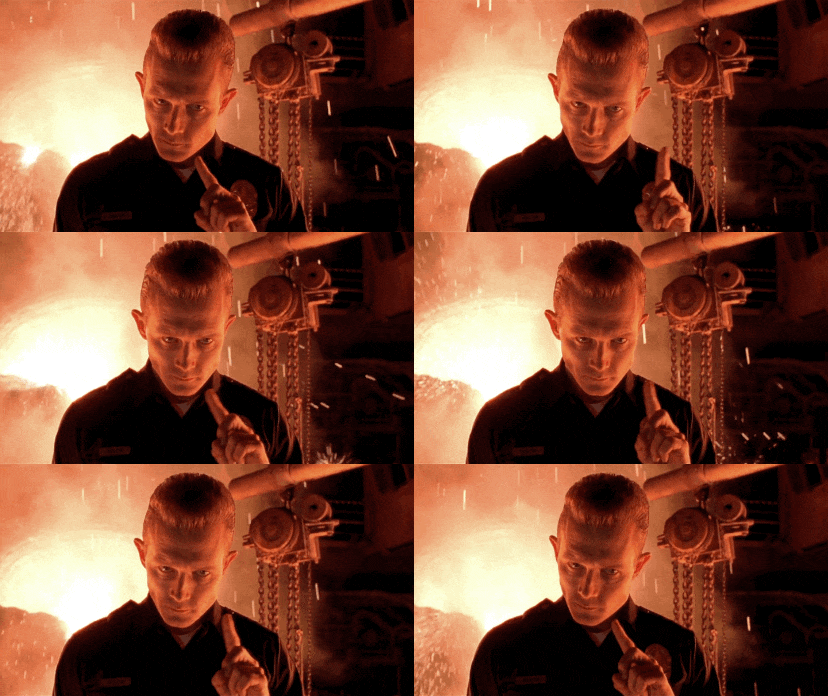
Terminator T-1000 – Robert Patrick
T-1000 catches a glimpse in the “mirror”
Then: Cold, silent, lean, sleek, sharp and relentless as a blade Robert totally had us as an exterminating machine made of liquid, mimetic metal.
Since then: Another victim of typecasting he did leave an impression in Walk The Line as Johnny Cash’s father, but it was on TV where he was given the opportunity to explore the range of his talent. He won awards and respect for his decent and dependable non- believer agent Doggett in The X-Files. He exposed a more soft, fragile side in both True Bloodas Alcide’s troubled werewolf father and From Dusk Till Dawn: The Series as a broken priest and parent. He is now staring as another decent and dependable government agent, Gabe Gallo, in CBS’s hit show Scorpion. Off screen he has been living a simple, tranquil, anti-Hollywood life with his wife of 27 years, Barbara, their daughter Austin and son Samuel. So far there are no plans for him to return to the Terminatorfranchise either.
Robert in Scorpion
Words of wisdom: No words. Just a menacing forbidding movement of the finger.
The Simple Facts
Watching Terminator 2 again on the big screen now the choice of the 3D conversion may seem questionable as it didn’t really add anything significant to it. Apart from that however its re-release made perfect sense as it proved its agelessness and enduring progressive qualities. At the same time, it faultlessly illuminated how little Hollywood invested in or boldly furthered Sarah’s legacy.
It is disheartening to realise how few, if any of our cinematic female action heroes have been so complex, tackling even motherhood while being total, unapologetic bad-asses and in no way sexually objectified. Indeed Mad Max: Fury Road‘s Imperator Furiosa is the only one that readily comes to mind, and she dropped our jaws only a couple of years ago. So it is most definitely about time for Sarah (and Jim) to return and remind us how it’s done.
Christopher Nolan’s genre-b(l)ending, unconventional masterpieces elevated him to the status of geek guru. There is the twisty, haunted and haunting psychological thriller, Memento. There is the truly magical performance in The Prestige that challenges notions of love, tragedy and sacrifice. There is the permanently marked by Heath Ledger’s genius The Dark Night: audacious, ground-breaking and perfectly balanced, both as a comic rendition and a sequel. There’s Inception: magnificent as an eye candy, original and imaginative as a study of the art and power of cinema, and yet full of empathy as it deals with loss and memory.
Dunkirkwas supposed to be his first “serious”, down to Earth, based on real, historical events film. So, nobody knew what to expect. Would he follow Steven Spielberg’s example and forsake his glorious geeky past for a more grown-up, awards-winning career? Or, would he, inexplicably, pull a Michael Bay and turn a factual, war tragedy (like the one at Pearl Harbour) into a pompous, patronising spectacle? Well, it turned out, he did, emphatically, neither. And as the Summer ends, let’s explore how Dunkirkbecame the most critically acclaimed and the only non-fandom movie in both the top five of the season’s American and the top 15 of the year’s world-wide box office thus far.
The virtual silence
On the beach, waiting in silence. [Source: Warner Bros.]It takes a while for a single word to be spoken on screen: “English” shouts a very young soldier in French with a thick English accent. He is allowed to take cover in the French fort before he is hastily and rather non-verbally guided to the beach, where his compatriots await rescue. And then again, it is a while longer for another piece of meaningful dialogue to be heard as this theme of verbal scarcity is constant throughout Dunkirk. Actors articulate only what is absolutely necessary. One example of this is when Commander Bolton states that the British military cannot evacuate the 400,000 stranded soldiers in time. Another is the irony of Churchill’s heroic words being read by a broken, boy soldier, at the end of the film. Most of the other dialogue is practically inaudible or consists of scattered words.
Dunkirk, you see, is nearly a silent film. It tells its story not with words, but with motion pictures accurately edited with fitting sounds as Hans Zimmer’s brilliant original music guides the pace of your heart with the appropriate tempo, communicating everything of substance in an uncensored, raw way. Case in point: the stretcher scene. After exchanging only a few looks, two soldiers understand and agree to perilously carry in haste one of the wounded to the hospital ship as a means of escaping the beach.
This narrative’s attitude of mistrusting (imposing) words is extended to Nolan’s choice of actors. The “main” character, Tommy, is played by an unknown youngster named Fionn Whitehead. Tom Hardy, who is now practically worshiped by fans and critics alike, once again (after The Dark Night Rises) hides most of his face behind a Spitfire pilot’s mask. The super star Harry Styles is borrowed from the pop music arena and is – to his and his director’s credit – unrecognisable. And while there’s Mark Rylance as Mr. Dawson, Cillian Murphy as his first, rescued passenger, Kenneth Branagh as Commander Bolton and James D’Arcy as Colonel Winnant, they are mainly known as either supporting actors or for their work behind the camera, and can barely be considered true celebrities.
No. The humans in this film are not larger than life: they are and could be anyone. You or me. Just people struggling to stay alive.
The deconstructed narrative
The sea meets the air. [Source: Warner Bros]Early on Dunkirkmaps out the different locations (The Mole/Earth, The Sea and The Air) and timelines (one week, one day, one hour, respectively) of each of the three threads of its narrative. Nolan does this simply and quietly, with a small piece of white text on the screen and no further explanation. So, you settle in your impression that the drama unfolds linearly and that the three stories occur concurrently. Except then it’s in the dark of night that one of the rescue ships sinks near the mole, but the events in the sea and in the air still transpire in the light of day.
The suspense that has been drumming your stomach is now augmented with senses of disorientation and anxiety as you realise that there a lot of people still stranded on the beach , having no idea that help is on the way. You grasp the danger Mr. Dawson’s mission is already in , miles away from the beach. And you feel deep in your core the bubbling panic of the rescued from the sea, shivering soldier, when he repeatedly, muttering or shouting, states, “I’m not going back”. Time is broken as events of the past (earth), the present (sea) and the future (air) happen in tandem on the screen. The three timelines converge only for a few moments, around and aboard Mr. Dawson’s boat, well past the mid-point of the film’s duration, before they break apart and never meet again. This lack of temporal regularity, of a clear beginning and a definite ending makes Dunkirkan interactive experience.
Yes. This storytelling creates a bond between the viewer and the characters: like these humans stranded on the beach or in the sea, you feel uncertain and maybe even terrified. You are there, with them. You don’t know or care if it’s day or night, if you win or lose the war, who is friend and who is foe. What matters is to stay alive.
The war after
The mole. [Source: Warner Bros]There are shootings, air fights, bombs dropping and ships sinking throughout the film, but Dunkirkdoes not actually explore this typically loud, bloody war. Instead it traces the one that comes after: the – soundless and bloodless – one fought deep inside and on a personal level, experienced as a common and at once a very lonely experience. This is the war that never really ends.
This is the war that strips everything away, apart from a ruthless survival instinct initially, and a brutal survivor’s guilt subsequently, when you are about to return to some kind of normality, of an everyday life. Where neither the instinct nor the guild can serve or save you. Where you are left naked, humiliated, wondering what was the point of all that you’ve survived. No matter the reassurances, or the gratitude you may receive, from Mr Dawson, the blind man welcoming you home, or the words of Churchill you read aloud from the newspaper. The latter in particular sound hollow, alien on your tongue, and anything but victorious, as they seem to speak about someone else and something else.
In tune with the proclamation of this film’s tagline (“Survival is victory”) the reality is that there are no war heroes here. No sense of accomplishment, fulfillment or redemption. As the fate of the haunted soldiers Mr. Dawson rescued on his boat, or the Spitfire’s pilot just captured by the Germans back on the beach you remain uncertain. Pendent. Thinking that if there is a hero here, this can only be George – Mr. Dawson’s young, wide-eyed shipmate. A boy who has never been to war or carried a gun. The only one who bleeds, and meets a certain faith and is specifically named and remembered in the paper.
But then again, no. You are not sure. You cannot settle on an answer. Is George the hero, or just an innocent victim?
The unorthodox blockbusting
Behind the scenes, Nolan directing Branagh [Source: Warner Bros]Uncensored by words, stars or heroes, fragmented in different timelines and points of view, with Zimmer’s evocative soundtrack acting as its “spinal cord”, Dunkirkis not meant to be watched. Is meant to be experienced. Viscerally. Deep inside. On a very personal level. By all of us, geeks, intellectuals and mainstreamers, together. Yet, simultaneously, by each of us so desperately apart. That is why there is no digital spectacle here, or high-tech CGI.
A passionate advocate of film, Nolan shot about 70% of Dunkirkin the full 70mm IMAX format, with a combination of 65mm IMAX and Super Panavision film for the remaining 30%. At the same time he insisted on using real boats, real Spitfire planes, real places, real people and old fashioned, handmade special effects to re-enact the action on the earth, in the sea and in the air. He thus composed moving images that are breath-taking in scale, clarity, texture, and, yes, beauty. But his greatest feat is how seamlessly, disarmingly immersive these images are. They are not meant to impress or to distract you. Only to pull you in.
Yes. Inescapably deep, into the war within. Where words fail you and time has no meaning.
It was hailed as Games of Thrones‘ best Season ever. Last year’s Season 6 however, was merely the show’s first, unavoidable attempt to reinvent itself unbound from its literary source – G. R. R. Martin’s A Song Of Ice and Fire series of books. It was a more or less successful attempt, about to be eclipsed by (at least) the current, trimmed, seven Season. This is how and why.
The… three-year itch
The lean, mean, head splitting and heart scorching first Season rocked the pop culture, geeks and non geeks alike, collectively and simultaneously on a very deep, personal level. The second Season lacked the novelty, but kept the stakes high for its persistently grey, main characters. It also retained its commanding, cinematic in scope production and direction standards. So, unlike other pop phenomena that boldly went where no part of their in print source has gone before (see Daryl and Rick’s and Michonne’s coupling in The Walking Deadfor example), David Benioff’s and D.B. Weiss’s creation was making TV history, while remaining meticulously faithful to Martin’s literary saga.
But then occurred the almost… catatonic Season 3, where very few things actually happened. At some point around midseason, Sam Tarly faced and defeated a single White Walker even though we were promised an army of them in the – jaw dropping – last scene in the Season 2 finale. Daenerys continued her liberating march by finally letting her dragons loose to punish her enemies. Both Jon Snow and Jamie Lannister were stripped to the bone, immersed into some sort of pool and underwent a kind of baptism/redefinition of character by two extraordinary women (Ygritte and Brienne of Tarth respectively). Meanwhile, Theon Greyjoy was relentlessly, interminably tortured by Ramsey Bolton in every other episode. And of course the (unnecessarily) brutal, infamous Red Wedding came to pass in Episode 9. Apart from these, easily fitting in three, maybe four episodes, significant developments, we were treated firstly with a lot of very long walks, a lot of very long talks. Secondly, with Podrick’s… sexcapades! Plus some new, secondary characters’ abrupt comings and goings – Yara Greyjoy’s more surprisingly, who we haven’t seen since last season. Yet, in Episode 10, she decides to set sail and go rescue her brother, even though she vehemently scorned him till then.
The long lasting shock-waves Red Wedding (in the marvel of a TV episode The Rains Of Castamere) send through any kind of public discussion were an inescapable distraction. So the fact that for a whole season of 10 incoherently paced episodes we were only given crumbs of character and story progression were more or less overlooked, with The New York Times’ Mike Hale being one of the very few unflappable enough to take notice. Benioff and Weiss had seemingly lost their magic touch. Their story telling was now drawn out, blubbering and uninspired. Stuck in an unfitting to TV, book-reading rhythm, as if they were no longer able to translate literature to motion pictures. It was as if they were waiting for something.
The remaining Stark kids
The never-ending (off screen) story
Season 4, covering the second part of the humongous, third book of Martin’s saga, exhibited signs of improvement early on as Joffrey’s fatal wedding took place in Episode 2– another fascinating, masterful TV hour. It also revealed that the show’s creators do possess the will and ability to productively veer off their source material after all, by choosing not to reincarnate Catelyn Stark as the vengeful Lady Stoneheart (in that instant at least). Yet, it soon became clear that the pacing of the series remained problematic. Substantial story highlights, like Tyrion’s trial or his and Cercei’s champions’ duel, were sporadic and far apart. Daenerys’ march began to lug, so much so that its aim was by now easily forgotten. The newcomers, including Margaery Tyrell, Stannis Baratheon and especially Oberyn Martell and Ellaria Sand, were not given enough space or time to be anything more than plot devices motivating some of the main characters actions and reactions. As a result we cared little for their fate. And questions for the show’s attitude towards women were raised again, (accusations of unnecessary nakedness and sexualisation of the female body had followed it from the very beginning), and this time with a vengeance due to Cercei’s virtual rape by Jamie at their son’s funeral.
At the same time, off screen, the drama of Martin’s inability to complete and deliver the long overdue, last two (6th and 7th) books of his Songwas peaking, with no end/due date in sight. The show’s home, HBO, its creators and the fans started to realise that soon they would have to venture into the unknown. The former would have to continue the story beyond the point that the conclusion of the 5th book had brought it. The latter would have to accept or find their way around the fact that in due course the series will inevitably start spoiling the books. And all had to come to terms with the reality that no amount of televised… stalling could make Martin write. Some bold, risky and fearless decisions had to be made.
To keep Bran Stark completely off Season 5 was the first of them. just when But it did seem like a bad omen, since on one hand he had just, finally met the Three Eyed Raven (and his destiny). And on the other, the pacing of the narration remained persistently and familiarly awkward in the first few episodes. New high profiled supporting characters like the High Sparrow, Tommen Lanister and the unholy trinity of Ellaria daughters, also known as the Sand Snakes predictably proved inconsequential in themselves. Simultaneously the cries lamenting female characters’ mistreatment intensified as Sansa suffered abuse on her wedding day to Theon’s torturer, Ramsey Bolton, Stannis’ teenage daughter was sacrificed to the Lord of Light, the most innocent of the Lanister brood, Myrcelaa was poisoned, and Cercei endured an extremely long, viciously humiliating walk of shame.
Yet, concurrently, midway through its 10 episodes run, this Season clearly picked up the pace, finding every so often the lean, mean, awe provoking rhythm of the show’s good old days. From Episode 6 onward in particular something… head splitting, heart scorching or outright spectacular happened. Systematicaly, usually at the concluding moments of each hour. Apart from the above female tragedies, there were Jon Snow’s and the wildling’s unexpected battle with the Night King and his ever expanding army of White Walkers, Daeny being rescued/kidnapped by one of her dragons, and of course the most socking and effective season finale the whole series had ever come up with: a gradual close up to Jon’s face as he lies dying on the snow, betrayed by the Night Watch .
Cercei and Jaime debating their future
A new hope… for spring
Jon’s death rattled the pop culture more and for much longer (all the way to the EMMYS, where Game Of Thrones finally won Best Drama) than the Stark patriarch’s beheading or the Red Wedding. Understandably, as Jon was a beloved character and since there was no more tales in print his fate was now uncertain. Again, some expressed anger, this time for the show’s choice to kill off one of their favourites, even though it was just adhering to the books. For others (myself included) however, Jon’s untimely and painful demise triggered an intrigued reinvestment to it. Even if the theory of Jon’s resurrection, heavily circulated by the hard core fans, proved right, spoiling some of our excitement. Because finally, all bets were off. How would the narrative evolve with only notes and suggestions by Martin? And how would Benioff and Weiss deal with the fact that – apart from a remaining bit of Bran’s story – from now on they would do the spoiling? An inevitability they only recently admitted.
Season 6 was not the revelation we had hoped for but it came very close to Game Of Thrones’ perfection during its inaugural year. Most of the supporting characters remained inconsequential in themselves, while now and then the show seemed to repeat itself, especially with Daeny’s another ordeal by and fiery triumph over the Drothaki. But from its first hour to its last, this was a journey full of emotional highs (Jon’s foretold resurrection, Hodor’s self-sacrifice holding the door), heady disclosures (Melisandre’s vulnerable, ancient true self, Cercei’s ruthless vengeance and accession to the throne) and bloody brilliant spectacles (The Battle Of The Bastards). Television greatness could be achieved without blindly following the literary original after all – a lesson Game Of Thronesshould have learned sooner.
Better late than ever though, particularly if this protracted, uneven route was what it took to reach the clarity of pace, temperament and spirit of the current, penultimate, only seven episodes long, Season Seven. Where, sure, Ellaria’s and her Sand Snakes’ utter uselessness and expendability were at long last – quickly and precisely – exposed. And where Theon has yet to really prove himself, along with the necessity of his punishingly stretched out torture back in Season 3. Never the less, there is no more stalling, no more waiting. Fire/ Daeny and Ice/Jon have finally met. The former’s rebirth as a reluctant, humble leader who campaigns for togetherness and understanding has become abundantly clear. Most of the remaining Stark children found each other again. The outcast Tyrion remained front and center in almost every episode, quietly but substantially advocating belief in diversity and inclusiveness. Daeny already led her horsemen and one of her dragons in battle once. The series substantiated its feminism by audaciously completing its portrayal of a varied array of strong, complex, anything but simply wives, mothers, lovers or daughters, female movers and shakers: from Queens Cercei, Daeny, old lady Tyrell and (very) young lady Mormont, to honorable soldiers Arya and Brienne, and a-force-to-recon-with in the making, Sansa. And all these in only four episodes. Yes, Season 6 and quite possibly Season 1 are about to eat dust.
I was hooked, I remember vividly, to Twin Peaks from its first ever episode. As Twin Peaks: The Return is about to reach its midseason point (at next week’s part 9), I find myself far from being hooked.
This is personal. As was the relation the legendary and groundbreaking original series built (for life) with its viewers/fans/cult followers. It drew us in by an – anything but farfetched – tragic event: the recovery of the body of Laura Palmer, a beautiful, promising young adult. Her strange demise stirred the secrets, lies and dysfunctionalities of her close-knit community and attracted oddball but endearing FBI Agent Dale Cooper (Kyle MacLachlan) to her small, rural town.
Immediately we cared for Twin Peaks population. Either because we were wide-eyed, rebellious, and more or less troubled youth, much like Laura, or any of her friends and schoolmates. Or as we were “responsible” adults/parents struggling to cope with both our life choices and our dues to the younger, demanding generation. Thus, the people Laura left behind became our people, their pains and tribulations, our pains and tribulations. And as they were gradually sucked into the uncanny, the Other place, the Black Lodge, so were we.
This was always David Lynch’s genius: to lure us in his bizarre, mysterious, irrational and often nightmarish universes via unexpectedly, yet effortlessly relatable characters. We instinctively saw ourselves in the mirror of the glorious imperfections, desires, plights and dreams of Blue Velvet’s Dorothy and Jeffrey, of Wild At Heart’s Sailor and Lula, of Mulholland Drive’s Betty/Diane and Rita, and, yes, of Twin Peaks’ Dale, Laura, Shelly, Harry, Dona, Audrey and James (to name just a few). Along with them we partook in all the weird, which consequently became familiar. Intimate.
Dale Cooper lost in the Black Lodge
Akin to all of Lynch’s work (even to his rare… straight stories) Twin Peaks existed on unsettled borders, the in between… Reality and unreality. Realism and surrealism. Natural and supernatural. Consciousness and sub-consciousness. Sweet dream and nightmare. Hope and fear. (Greek) Tragedy and soap opera. Crime drama and fantasy thriller. Comedy and melodrama. Rom com and horror! Motion pictures and video art. Linear was only the course of their perception. They were first received emotionally, by the heart and then rationally by the mind, ultimately expanding both. Being experienced, rather than simply watched.
This is not the case with the… über hyped Return. From the initial moments of its first episode the uncanny is front and centre with scarcely any relatable character in sight. Instead we are faced with a mysterious glass box, a gruesome killing of a love-making couple in front of it, Special Agent Cooper still trapped in the Black Lodge, his vicious, inhabited by Bob doppelgänger still out and about among us, a horrific, mysterious murder in South Dakota, and only some sporadic glimpses of the people we know and love.
As the two parts opener ends at the bar where Shelly (Mädchen Amick) and her friends discuss the realities of their adult everyday life over drinks however, and soon after “good” Cooper seems to find his way out of the Other place, expectations bloom and the heart drums. Is the Return about to become real? Alas, no. Due to “bad” Cooper’s nefarious (and quite disgusting) plots, “good” Cooper is not fully back. He returns far from Twin Peaks, as – a suddenly slim – Dougie Jones, a (former) cheater husband, absentee father and useless both as an employee and a small time crook, who currently walks around helpless as an infant, constantly spaced out and virtually mute.
Simultaneously the forays back to Twin Peaks are rare, fleeting and far between. Worse, when they do occur, little of substance is disclosed of what happened to our people in the last 25 years. Sure, Tommy “Hawk” is still the deputy Sheriff, Benjamin (Richard Beymer) still runs the hotel and argues with his brother, Margaret (Catherine E. Coulson) still listens to and relays messages from her log, Shelly still works at Norma’s (Peggy Lipton) diner and Lucy (Kimmy Robertson) remains the goofy receptionist of the Sheriff’s office. But how and why? And beyond these persisting norms, what? In the place of answers we get a couple of hasty introductions to the latter two’s offspring: Becky (as a somewhat younger version of Lula, tripping in her desperately immature and irresponsible boyfriend’s convertible) and Wally (as a – meant to be – hilarious homage to Marlon Brandon’s The Wild One), incarnated by Amanda Seyfried and Michael Cera, respectively.
To the above, more or less blink and you missed them… celebrity sightings add those of Naomi Watts (as Dougie’s wife), Ashley Judd (as Benjamin’s secretary), Laura Dern (as one of Special Agent Cooper’s former partners) Jenifer Jason Lee (as one of “bad” Cooper’s minions), Harry Dean Stanton (as Carl, who witnesses a freak automobile accident and the subsequent ascendance of a little boy’s soul to heaven), James Belushi (as a casino executive) and Richard Chamberlein (as David Duchovny’s FBI Chief Denise Bryson)! Who are all these people apart from their well-known performers (so infatuated with their director that they will do even… nothing for him)? And why should we care? … Silencio.
This is Dougie. Who?
This Return commits all the sins the quite lamented 2nd season of the original series committed, and then some. It “babbles” its story on throughout doubled in numbers episodes than its initial conception (the first ever season was 8, while the current one was first announced as a 9 parts one). It introduces an array of new characters and plot-lines that come off minimum relevant to and end up annoyingly distracting from its core story and heroes. It deliberately forgoes its precious balance on the borders, abruptly veering towards the one or the other direction – usually the extremely bizarre. Case in point the mostly abstract, black & white latest episode 8, which nevertheless seemed as a wacky explanation of Bob’s and Laura Palmer’s origins! And whereas 25 years ago we had our beloved people to carry us through and keep us hooked, now we are afforded no such comfort.
Hence the course of our perception is disrupted. Our emotion lies dormant. And without it logic cannot accept the uncanny. So it stays unfamiliar and alien. Void, inane and pretentious. Not an experience, just a conceited visual brain-teaser.
What is left to say? Kudos to Showtime for giving David Lynch and his co-creator Mark Frost free rein to experiment with the conventions of the TV procedural drama. Kudos also to Lynch himself for writing, directing and producing the whole series, while also staring as the always oddly charming FBI Deputy Director Gordon Cole. Kudos lastly to the passionate fan in me that even now hopes beyond hope that the next 9 parts of this Return will be more of the series I know and love. Thus far however, this is not my town. These are not my people. This is not my weird. And sure as hell this is not my Dale Cooper.